
How to Choose a Canadian IPTV Subscription That Actually Delivers
Compare Canadian IPTV subscriptions in 2026. Learn what to look for, what red flags to avoid, and which service delivers for Toronto households.

Hundreds of streaming services promise the world, but most leave you frustrated, buffering, or locked out of the content you actually want to watch. If you are living in Canada and tired of overpaying for cable or settling for unreliable streams, finding the right Canadian IPTV subscription can be a game changer.
But here is the problem: the market is flooded with options, and not all of them are created equal. Some providers offer thousands of channels but deliver poor picture quality. Others look great on paper but fail the moment you sit down to watch a live hockey game or your favourite series.
That is exactly why this guide exists. We have done the research so you do not have to. In the sections ahead, you will find a clear, honest comparison of what separates a trustworthy Canadian IPTV subscription from one that will waste your time and money. Whether you are completely new to IPTV or simply looking to switch providers, you will walk away knowing exactly what to look for before you commit to a single dollar.
Why Canadians Are Ditching Cable for IPTV in 2026
Traditional cable in Canada has long operated on a simple but frustrating premise: pay for hundreds of channels you will never watch in order to access the handful you actually want. Monthly bills routinely climb well past what most households consider reasonable, with equipment rental fees, administrative charges, and annual price increases quietly compounding the damage. For years, Canadians accepted this arrangement because there was no credible alternative. That calculation has fundamentally changed.
IPTV subscriptions now give households direct control over their entertainment spend. Flexible plans ranging from $15 to $50 per month deliver comparable or broader content access than traditional cable, with no long-term contracts and no surprise fees on the monthly statement. Subscribers pay for what they actually use, and they can cancel or switch plans without penalty. That kind of financial flexibility simply does not exist inside a two-year cable agreement.
2026 represents a genuine turning point for the Canadian IPTV market. Server infrastructure has stabilized considerably compared to the buffering-prone early years, and 4K streaming is now the baseline expectation rather than a premium tier. Consumer adoption is accelerating as a result, with IPTV growth actively cutting into traditional Canadian cable and satellite subscriber bases rather than simply attracting fringe early adopters.
When Canadians who have switched are asked why, three drivers surface consistently. First, flexibility in when and how they watch, using any screen without proprietary hardware. Second, access to international channels, niche sports, and content their cable provider simply does not carry. Third, straightforward monthly pricing with no hidden charges. As detailed in research on why Canadians are switching to IPTV, these are not minor conveniences; they are structural advantages over the legacy cable model.
The way Canadians discover IPTV services has also shifted decisively. Review-driven YouTube content, including "Top 5 IPTV Canada" comparison videos, is now accumulating tens of thousands of views within months of publishing. This confirms that most new subscribers arrive through independent research rather than provider advertising, making honest, side-by-side comparisons the most valuable tool available to anyone evaluating a Canadian IPTV subscription for the first time.
What to Look For in a Canadian IPTV Subscription
Choosing the right Canadian IPTV subscription comes down to five concrete evaluation criteria. Understanding each one before you commit to a plan will save you from overpaying for a service that underdelivers.
Server Stability Comes First
Server infrastructure is the single factor that separates a premium viewing experience from a frustrating one. Services running on private, load-balanced servers physically located within North America consistently deliver 4K streams above the critical 18 Mbps threshold, which is the minimum required for stable high-resolution playback. Shared cloud infrastructure, by contrast, frequently stutters and buffers during peak viewing hours, precisely when you are most likely to be watching. If you are streaming live hockey, CFL games, or Premier League matches, a weak server will ruin the experience regardless of how fast your home internet is. Always test any service during Saturday evening peak hours, not at midday, since off-peak performance tells you very little about real-world reliability.
Channel Count Claims Can Be Misleading
A provider advertising "10,000+ channels" sounds impressive until independent testing reveals fewer than 300 reliably active feeds. This gap between marketing and reality is one of the most widely documented problems in the Canadian IPTV market. Rather than focusing on headline numbers, ask specifically about verified active feed counts and uptime data. Raw channel totals without reliability figures are not useful for making a sound purchasing decision.
VOD Freshness, EPG Accuracy, and Trust Signals
For on-demand content, update frequency matters more than catalog size. A library refreshed daily holds far more practical value than a bloated but stale archive. According to current IPTV research for Canadian subscribers, EPG accuracy is now a standard evaluation column in comparative reviews, because an inaccurate or delayed program guide degrades the daily viewing experience even when stream quality is strong.
Finally, credible providers distinguish themselves through transparent pricing, responsive customer support via live chat or a ticketing system, and the availability of a free trial period. Per the 2026 Canadian IPTV guide, any provider worth considering should offer a trial before requiring a long-term commitment. The absence of one is a clear warning sign. Start with a monthly plan on any unfamiliar service before considering annual pricing.
Red Flags and Misleading Claims to Watch Out For
Knowing what to look for in a quality service matters, but knowing what to watch out for is equally important. The Canadian IPTV market contains a significant number of providers making claims that do not hold up under scrutiny. These five red flags will help you filter out misleading offers before you commit a single dollar.
Inflated Channel Counts
The most widespread deceptive tactic in the Canadian IPTV market is the inflated channel count. Providers advertising "10,000+ channels" routinely deliver fewer than 300 reliably active feeds according to independent testing. The gap exists because these services pad their channel lists with dead feeds, duplicate entries across multiple languages, and pirated streams that drop without notice. A headline number is a marketing figure, not a measure of actual viewing reliability. When evaluating any Canadian IPTV subscription, ask specifically how many channels are consistently live, not how many are listed.
Misuse of CRTC Regulatory Language
The CRTC does not certify or approve consumer-facing IPTV subscription services. Any provider claiming to be "CRTC-compliant" or "CRTC-approved" is using regulatory language as a marketing tactic rather than as a verifiable credential. As Yale Journal on Regulation's analysis of Canadian IPTV legal status confirms, CRTC licensing applies to major broadcast undertakings, not to the gray-market subscription services most consumers encounter. If a provider cannot point to a specific, publicly searchable CRTC broadcasting licence number, the compliance claim means nothing.
Blackouts After You Have Already Paid
Most consumer-facing IPTV services operate as unlicensed retransmission resellers. The practical consequence is unexpected blackouts of local news, regional sports, and live events because rights enforcement targets high-value live content first. As this 2026 overview of IPTV legality in Canada notes, subscribers typically discover these disruptions only after committing to a 12-month plan. There is no refund path when the service degrades because the provider has no contractual obligation to maintain the feeds it was never licensed to carry.
Hidden Fees and Opaque Pricing
Hidden fees and unclear plan structures are among the most common complaints filed against Canadian IPTV providers. Low entry prices of $10 to $15 per month frequently serve as an entry point for undisclosed setup charges, per-device connection fees, and auto-renewal terms buried in fine print. Legitimate providers publish complete pricing, connection limits, and renewal terms on a public-facing page without requiring a sales call. If you cannot find the full cost of a plan before entering a billing conversation, treat that opacity as a deliberate signal.
No Trial Period Offered
The absence of a trial period or money-back window is itself a meaningful warning sign. Providers confident in their infrastructure offer test periods because they expect the service quality to earn the subscription. Unlicensed providers frequently push consumers directly into long-term commitments precisely because a short trial window would expose the service's instability before payment is locked in. A reasonable trial benchmark is anywhere from 24 hours to 7 days of full access. Any provider unwilling to offer even a limited test window is signalling something it would prefer you not discover until it is too late.
What the CRTC Actually Regulates (And What It Does Not)
The CRTC (Canadian Radio-television and Telecommunications Commission) regulates licensed broadcasters and broadcasting distribution undertakings (BDUs) operating over cable, satellite, and terrestrial infrastructure. Its mandate, established decades before the internet existed, was built around closed broadcast systems with identifiable licensees, not consumer-facing subscription packages sold online. That foundational distinction matters enormously when evaluating claims made by IPTV providers.
No consumer IPTV subscription provider in Canada holds CRTC certification for its streaming service as a product. The regulatory framework simply does not include that category of approval. Canada's Online Streaming Act (Bill C-11), enacted in April 2023, extended CRTC authority to large online platforms earning more than C$25 million in annual Canadian broadcasting revenues. As the Yale Journal on Regulation's Bill C-11 analysis confirms, regulatory obligations for smaller IPTV subscription services "remain fluid," meaning the typical provider a Canadian consumer encounters operates outside any verifiable CRTC oversight structure entirely.
When a provider claims "CRTC compliance" or "CRTC certification," treat that phrase as a marketing claim until proven otherwise. Ask for a specific licence number or a regulatory decision reference verifiable on the CRTC's public registry. Without documented proof, the claim is designed to manufacture credibility, not reflect it. CRTC status and copyright compliance are also separate questions entirely; a service can sidestep one issue while remaining exposed on the other. Not all IPTV services carry equal legal or operational risk, but Canadian consumers cannot use CRTC status alone as a reliable measure of provider legitimacy.
Toronto and GTA-Specific Considerations for IPTV Subscribers
Choosing a Canadian IPTV subscription becomes significantly more practical when you evaluate providers through the specific lens of where you live. For GTA households, several considerations move well beyond general advice and become genuine dealbreakers.
Local Channels Are Non-Negotiable
Before committing to any plan, confirm that the provider carries CP24, City Toronto, CBC Toronto, Global Ontario, and CTV Toronto. These channels are not decorative additions to a package; they deliver local news, weather alerts, and emergency broadcasts that GTA residents depend on daily. Budget and international providers frequently omit these feeds entirely, leaving subscribers without the local programming they assumed was included. Always verify the exact channel list before paying, not after.
Regional Sports Feeds for Toronto Fans
Generic "TSN" or "Sportsnet" listings in a channel guide do not guarantee Ontario-specific regional feeds. Leafs playoff coverage, Raptors games, Blue Jays broadcasts, and TFC matches are carried on Sportsnet Ontario and TSN regional feeds that national or internationally routed providers often replace with alternate regional signals or drop altogether. When evaluating any service, ask specifically whether the Ontario feed variants are included, not just the national network name. According to independent provider reviews for 2026, verifying regional sports access during peak NHL hours is one of the most reliable stress tests for any Canadian IPTV subscription.
Server Location Affects Your Daily Experience
Providers running infrastructure on North American servers deliver measurably lower buffering and latency for GTA subscribers. Services routing traffic through overseas data centres introduce lag that is particularly disruptive during live sports. Ask any provider directly where their servers are located before subscribing.
Multicultural Programming Sets GTA Apart
Toronto is among the most culturally diverse cities globally, and a strong IPTV provider reflects that. Look for packages covering South Asian, Chinese, Caribbean, Portuguese, Italian, Filipino, and Middle Eastern channels, as these are programming needs that traditional cable handles poorly and at significant cost.
Toronto's Best IPTV is built specifically for this market. Its server infrastructure is optimized for Canadian connections, its channel lineup includes confirmed local Toronto feeds and Ontario regional sports, and it carries one of the broadest multicultural channel selections available from a GTA-focused provider, making it a practical first choice for households across the Greater Toronto Area.
IPTV for Multicultural and Expatriate Households in Canada
Canada is one of the most culturally diverse countries in the world, and the Greater Toronto Area sits at the centre of that diversity. Yet traditional cable providers have consistently failed to reflect that reality in their channel offerings. International programming has historically been treated as a premium add-on, with specialty packages priced well above standard tiers, restricted to a narrow selection of regions, and often poorly organised. For a household trying to access programming from South Asia, the Caribbean, or West Africa, the cable model has never been a practical solution.
IPTV fundamentally changes this dynamic. A single Canadian IPTV subscription now delivers live channels from South Asia, East Asia, the Middle East, Africa, Latin America, the Caribbean, and Europe without requiring separate add-on purchases for each region. South Asian feeds alone can include Star Plus, Sony Entertainment, Colors TV, Zee TV, Geo TV, ARY Digital, and regional Indian language channels covering Tamil, Telugu, Malayalam, Kannada, Bengali, and Punjabi. Arabic viewers can access MBC Group channels, Al Jazeera, Dubai TV, and Rotana. Korean viewers can access KBS, MBC, SBS, and JTBC. These are not curated highlights; they are comprehensive regional libraries delivered within one subscription.
For expatriate households specifically, the value goes beyond convenience. Home-country news, live sports, religious programming, and cultural events are content categories that Canadian cable packages simply do not carry at any price point. IPTV resolves an availability problem, not just a cost problem.
When evaluating providers for international content, channel count alone is a misleading metric. A provider listing 200 South Asian channels but reliably delivering only 30 of them is objectively less useful than a provider listing 80 with verified, consistent uptime. Prioritise feed reliability over catalogue size, as outlined in 2026 IPTV provider rankings.
Toronto Best IPTV addresses this directly. Its international packages are designed specifically for the GTA's multicultural population, covering dozens of languages and regions with verified active feeds rather than inflated listing totals. For households where international programming is not optional but essential, that distinction is what separates a subscription that works from one that simply looks good on a pricing page.
Device Compatibility: What Works With Canadian IPTV
One of the most practical advantages of a modern Canadian IPTV subscription is that it works with hardware you likely already own. Unlike traditional cable, which locks you into proprietary set-top boxes, IPTV delivers your content through internet-connected devices ranging from Smart TVs and streaming sticks to smartphones, tablets, and computers. Understanding which device suits your setup best makes the difference between a seamless viewing experience and a frustrating one.
Amazon Fire Stick
The Amazon Fire Stick is among the most popular IPTV devices in Canada, largely because it is affordable, widely available, and straightforward to configure. To get started, download an IPTV player app such as IPTV Smarters or TiviMate from the Amazon App Store. If your preferred app is not listed, you can enable "Apps from Unknown Sources" in the Fire Stick settings and sideload the app manually using a tool like Downloader. Once installed, enter the M3U playlist URL or Xtream Codes credentials provided by your IPTV service, and your full channel list populates automatically.
Android TV Boxes
Android boxes offer the greatest flexibility of any IPTV device, making them a strong choice for viewers who want to customize their experience. Install your preferred IPTV player directly from the Google Play Store, enter your provider credentials, and configure your EPG source URL to activate the electronic program guide. The EPG displays scheduling data for upcoming programs, which many subscribers find essential for navigating large channel libraries. According to Top 5 IPTV Services in Canada 2026, popular player apps including TiviMate and XCIPTV are fully compatible with Android-based hardware.
Smart TVs
Smart TV compatibility depends heavily on brand and operating system. Samsung and LG users can typically install IPTV player apps directly from their manufacturer's app store without any additional hardware. Owners of other Smart TV brands may need to use screen mirroring from a smartphone or connect an external streaming device to achieve the same result.
MAG Devices and Other Options
MAG set-top boxes deliver a lean-back experience closest to traditional cable television. Setup involves navigating to the device's system settings and entering the portal URL supplied by your provider, with no app installation required. Beyond dedicated hardware, iOS and Android smartphones, tablets, and desktop computers via browser or dedicated apps are all fully supported by reputable services. As confirmed by IPTV Canada 2026 provider comparisons, multi-device support across these platforms is now a standard expectation at every price tier, giving Canadian households the freedom to watch on whichever screen suits the moment.
Internet Speed Requirements for IPTV Streaming in Canada
Your internet connection is the foundation of your IPTV experience, and understanding the speed requirements for each resolution tier will help you choose the right plan and set accurate expectations before you subscribe.
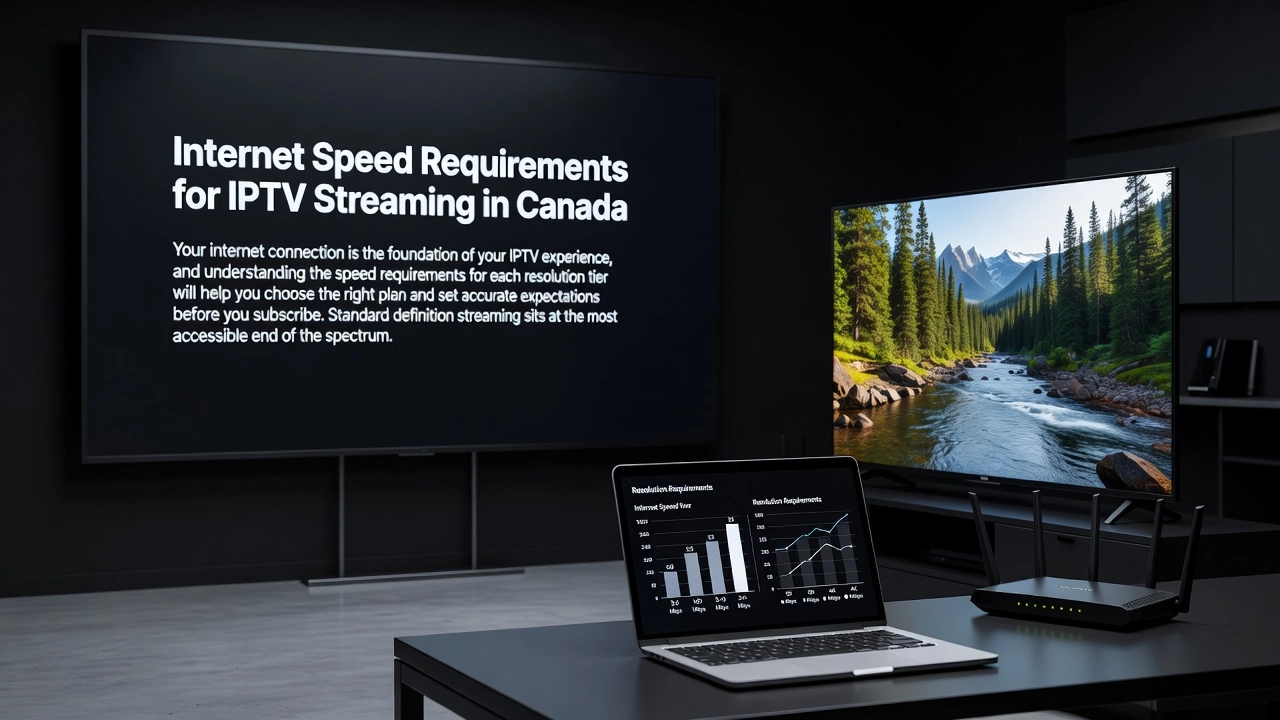
Standard definition streaming sits at the most accessible end of the spectrum. SD streams require a minimum of 5 Mbps for a stable, consistent picture. The vast majority of Canadian households on any modern broadband plan will exceed this threshold without effort, as the CRTC's basic service objective currently sits at 50 Mbps download for fixed internet. SD is rarely the bottleneck in a typical Canadian home.
Full HD (1080p) streaming raises the requirement meaningfully. A sustained connection of 10 to 15 Mbps is necessary for freeze-free HD viewing, but that figure only accounts for the IPTV stream in isolation. When someone else in the household is gaming, video calling, or downloading large files on the same network, bandwidth competition becomes a real problem. For households in this situation, targeting a 25 Mbps plan or higher provides the headroom needed to prevent interruptions on the primary viewing screen.
4K streaming demands the most from your connection. While the IPTV server must sustain a minimum of 18 Mbps output per stream to deliver stable 4K content, your home internet connection needs additional room to absorb real-world fluctuations from Wi-Fi interference, peak-hour congestion, and background device activity. Planning for 25 to 35 Mbps dedicated to a single 4K stream is the practical standard. For multi-device households running two 4K streams alongside one HD stream simultaneously, total available bandwidth should reach 75 to 80 Mbps, with a wired Ethernet connection or 5 GHz Wi-Fi strongly recommended for the primary screen.
One critical point that beginners frequently overlook: a fast home internet plan cannot compensate for weak server infrastructure on the provider's end. A household with a 1 Gbps home connection will still experience buffering and dropped frames if the IPTV provider's server cannot sustain 18 Mbps output per individual stream. In most real-world IPTV performance complaints, the bottleneck is the provider's server capacity, not the subscriber's home connection. This is precisely why server quality and infrastructure reliability must be evaluated as seriously as channel count when choosing a Canadian IPTV subscription.
IPTV Pricing in Canada: What Is Realistic in 2026
Verified pricing data for balanced Canadian IPTV options in 2026 sits between $15 and $50 per month, with the variation driven by three primary factors: the number of simultaneous connections included, the depth of the VOD library, and the scope of the channel package. A single-connection plan with a modest channel lineup will land at the lower end of that range, while multi-connection packages with comprehensive international channels and a large on-demand library approach the upper tier. Understanding where a plan falls within this spectrum helps you match the service to what your household actually needs, rather than paying for features you will never use.
Plans priced below $15 per month deserve careful scrutiny before you commit. At that price point, providers are almost always cutting costs somewhere, and the most common sacrifice is server infrastructure. Underpowered or shared servers translate directly into buffering, dropped streams, and unreliable uptime, particularly during peak viewing hours or live sports events. Budget-tier services frequently advertise inflated channel counts, sometimes claiming 10,000 or more channels, while independently verified testing consistently finds fewer than 300 reliably active feeds. The savings are rarely worth the frustration.
The $20 to $35 per month bracket represents the strongest overall value for most Canadian households. Plans in this range typically include a wide channel selection, access to a substantial VOD library, and multiple simultaneous connections without crossing into enterprise-tier pricing. For households streaming hockey, international sports, or multilingual content, this mid-range tier is where server quality and content reliability genuinely improve.
Annual plan discounts are widely available across the industry, often ranging from 20 to 40 percent off monthly rates, but they carry real risk with unproven providers. Committing to 12 months before testing service quality is precisely how most subscriber complaints begin. Always trial a service on a monthly plan first, test it during peak hours, and verify that your specific channels load correctly before considering a longer commitment.
Pricing transparency remains a genuine gap across much of the market. torontobestiptv.ca addresses this directly by publishing clear, tiered pricing with no hidden activation fees, no undisclosed connection limits, and straightforward renewal terms, so subscribers understand exactly what they are paying before they sign up.
Why a Free Trial Period Should Be Non-Negotiable
A trial period is not a courtesy feature; it is your primary diagnostic tool before committing to any Canadian IPTV subscription. During a trial, you can verify that stream stability holds on your specific home internet connection, confirm that your preferred devices load the service correctly, and check that your most-watched channels are reliably active rather than simply listed in a menu. Passive browsing during a trial tells you very little. Active, structured testing tells you everything you need to know.
Test live sports during peak hours. The single most revealing trial test you can run is loading a live sports stream between 7 PM and 11 PM on a weeknight or weekend. This is when server load peaks across all IPTV infrastructure. Lower-quality providers will exhibit buffering, dropped frames, or complete stream failures during these windows, particularly during high-demand broadcasts like NHL games, Premier League matches, or CFL playoff coverage. If a service handles sports cleanly under peak load, it will handle everything else comfortably.
Verify EPG accuracy across multiple channels. Open the electronic program guide and confirm that program information is correct, current, and loading without errors across a range of channels. An EPG showing "No Information," incorrect broadcast times, or stale descriptions is a direct indicator of neglected backend maintenance, not a minor cosmetic issue.
Check international channels at different times of day. If your household watches content from South Asia, the Middle East, Europe, or Latin America, do not simply confirm those channels appear in the list. Load several from your target region during both off-peak mornings and peak evenings to confirm consistent feed reliability under varying server conditions.
Toronto's Best IPTV offers a trial period specifically so new subscribers can run these tests firsthand, reflecting genuine confidence in the service infrastructure and content reliability behind every plan.
Why Toronto Best IPTV Stands Out for Canadian Subscribers
Toronto's Best IPTV was built from the ground up with Canadian subscribers in mind, and that foundational difference shows across every aspect of the service. Where many IPTV providers operate on overseas server infrastructure and route data across long international paths, Toronto's Best IPTV relies on server infrastructure optimized for North American connections. For GTA households, this means live streams arrive with far lower latency than services routing through distant data centers. During peak viewing hours, including playoff hockey nights and weekend Premier League matches, that local routing advantage directly translates into fewer buffering interruptions and more consistent picture quality.
Channel transparency is another area where Toronto's Best IPTV separates itself from the field. Budget providers frequently advertise channel counts in the tens of thousands while delivering far fewer reliably active feeds. Toronto's Best IPTV takes a different approach: subscribers receive clear, accurate reporting on exactly which active channels are included in their package, so there are no unpleasant surprises after payment.
Device compatibility is broad and genuinely practical. The service works seamlessly across Smart TVs, Fire Sticks, Android boxes, MAG devices, smartphones, and tablets. Setup is straightforward, and responsive customer support is available for subscribers who need configuration assistance regardless of their technical experience level.
For Toronto's multicultural population, the international channel depth stands out as a meaningful advantage. Toronto's Best IPTV offers one of the widest multilingual channel selections available from a Canadian provider, with reliable international feeds spanning dozens of languages and regions, serving expatriate and heritage-language households throughout the GTA.
Pricing is competitive, clearly published, and free of hidden fees. A trial option is available so new subscribers can personally verify stream quality before committing to a longer plan, which is the standard any credible Canadian IPTV subscription should meet.
Making the Right Choice: Key Takeaways
Selecting the right Canadian IPTV subscription comes down to cutting through marketing noise and verifying what actually matters before you spend a dollar. Server stability and confirmed active channel counts are your two most important benchmarks; a provider advertising 10,000 channels but reliably delivering fewer than 300 is not a bargain at any price.
Treat any "CRTC-compliant" claim as a red flag unless the provider can produce verifiable licensing documentation. The CRTC does not certify consumer IPTV subscription services, and this phrase is marketing language, nothing more.
For GTA households, confirm that local Toronto and Ontario regional channels are included before subscribing. If you follow the Leafs, Raptors, Blue Jays, or TFC, regional sports coverage is non-negotiable, and discovering a gap after paying is a costly mistake.
Always begin with a monthly plan or free trial. Test stream quality, EPG accuracy, and device compatibility on your actual setup before committing annually. Toronto Best IPTV is built on exactly this trial-first, transparent-pricing model designed for GTA and Canadian households. Visit torontobestiptv.ca to explore current packages and start your trial today.
Conclusion

Choosing the right Canadian IPTV subscription does not have to be overwhelming. By focusing on stream reliability, channel selection, customer support, and transparent pricing, you can cut through the noise and find a service that genuinely delivers. Avoid providers that make big promises without offering trial periods or verifiable reviews. Prioritize quality over quantity, because a smaller, stable channel lineup beats thousands of unwatchable streams every time.
Now it is time to put this knowledge to work. Use the criteria outlined in this guide to evaluate your options, ask the right questions, and test before you commit. The perfect streaming experience is closer than you think. Stop settling for buffering screens and broken promises. Make a confident, informed choice today and finally enjoy the content you love, on your terms, without overpaying for it.